












Description
What Is the DAXIN 3H3 300K-T 300kVA Online UPS?
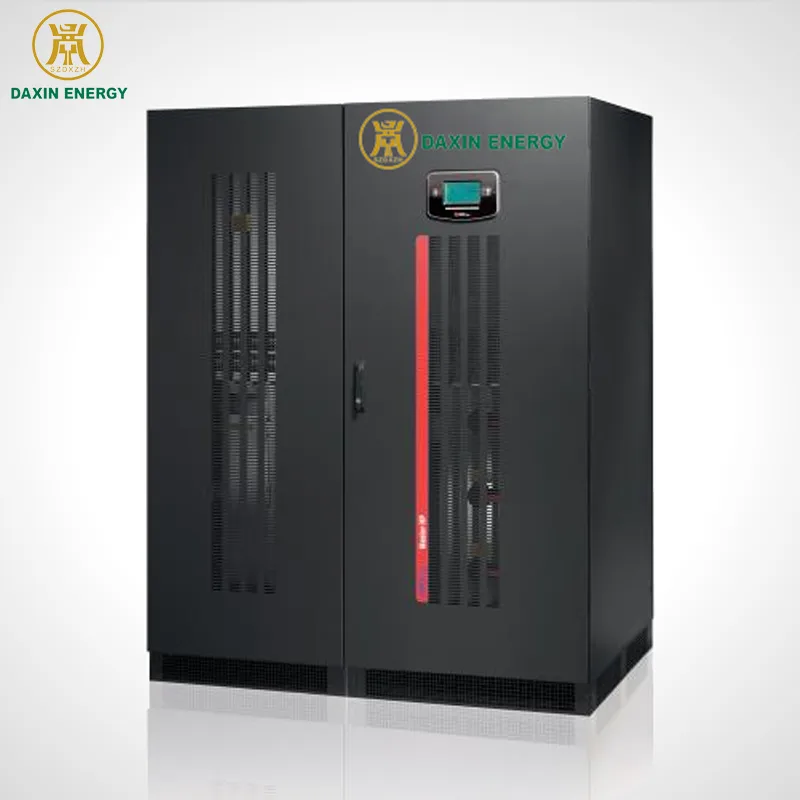
The DAXIN 3H3 300K-T is a 300kVA/270kW low-frequency 3/3 phase double-conversion online UPS designed for large industrial, data center, infrastructure and mission-critical power applications.
Its three-phase input and three-phase output architecture supports facilities operating large three-phase critical loads. The reference specification supports 380/400/415VAC input, an input power factor greater than 0.99 and input current THDi below 3%.
The UPS provides 300kVA apparent power and 270kW active power, with static output voltage stability of ±1%, dynamic voltage stability of ±5% within 10ms and a 3:1 crest factor.
Battery technology, bypass configuration, communication interfaces and other project options should be selected according to the required backup time, site electrical system and approved DAXIN technical proposal.
Key Benefits
- 300kVA / 270kW Capacity: Designed for large three-phase mission-critical loads in industrial and infrastructure applications.
- Double-Conversion Online Architecture: Provides continuous conditioned power for critical electrical equipment.
- 3/3 Phase Configuration: Three-phase input and three-phase output support large industrial and infrastructure electrical systems.
- Grid-Friendly Input Performance: Input power factor greater than 0.99 and input current THDi below 3% help reduce upstream electrical impact.
- Stable Output Performance: Static voltage stability of ±1%, dynamic voltage stability of ±5% within 10ms and a 3:1 crest factor support sensitive critical loads.
- Strong Overload Capability: The reference specification supports 110% load for 60 minutes, 125% for 10 minutes and 150% for 1 minute.
- Flexible Energy Storage: Multiple battery and energy-storage technologies can be evaluated according to project requirements.
- High-Efficiency Smart Mode: Smart-mode efficiency is specified at up to 98.5%.
Battery and Energy Storage Options
The DAXIN 3H3 300K-T can be engineered with different energy-storage technologies according to project requirements.
- Valve-regulated sealed lead-acid batteries
- Nickel-cadmium batteries
- Supercapacitor systems
- Lithium battery systems
- Flywheel energy-storage systems
The final energy-storage technology, capacity and backup autonomy should be selected according to the connected load, required runtime, operating environment, lifecycle requirements and approved project design.
How Much Load Can a 300kVA UPS Support?
The DAXIN 3H3 300K-T is rated at 300kVA apparent power and 270kW active power. The actual connected load should remain within the approved operating limits and should include an appropriate design margin.
UPS sizing should consider the actual load in both kW and kVA, load power factor, startup or peak demand, future expansion, redundancy requirements and required battery autonomy.
For large critical-power projects, DAXIN ENERGY can review the load list and single-line diagram before confirming the final UPS and battery configuration.
What Does 3/3 Phase Mean in a UPS?
A 3/3 phase UPS uses three-phase AC power at the input and supplies three-phase AC power at the output.
This architecture is commonly used for high-capacity critical loads in data centers, industrial plants, power infrastructure, transportation systems and other facilities operating large three-phase electrical equipment.
The DAXIN 3H3 300K-T provides a 300kVA/270kW three-phase online UPS platform for these large critical-power applications.
Product Views and Technical Reference

Typical Applications
- Large data centers and mission-critical IT facilities
- Industrial manufacturing and process-control facilities
- Power generation and utility infrastructure
- Telecom core facilities
- Hospitals and healthcare campuses
- Transportation, railway and tunnel infrastructure
- Commercial and public infrastructure
- Other high-capacity three-phase critical-power systems
How to Select a 300kVA Three-Phase UPS
Select the UPS according to the measured critical load in kW and kVA, power factor, peak demand, input and output voltage, required operating margin, future expansion, battery autonomy, bypass architecture, redundancy target, communication requirements and installation environment.
For a 3/3 phase UPS, confirm that both the facility electrical supply and protected critical loads require three-phase power.
Large-capacity UPS projects should also evaluate upstream and downstream protection coordination, generator compatibility, battery-system architecture, maintenance access, ventilation, floor loading and system redundancy before final equipment selection.
Provide DAXIN ENERGY with the load list, single-line diagram and site requirements for project-specific UPS and battery configuration.
Frequently Asked Questions
Can this product be configured for a specific project?
Yes. Electrical configuration, battery runtime, communications, bypass, cabinet arrangement and project accessories can be reviewed against the site requirements.
Are all technical ratings shared across the full series?
No. Ratings and functions vary by model and configuration. Use the project-specific technical sheet as the final reference.
Can DAXIN ENERGY support system selection?
Yes. Provide the load list, phase and voltage, required runtime, redundancy target, communication requirements and installation environment.
Request a Project Configuration
Send the load data, single-line diagram, required backup time and site conditions to receive a tailored UPS or battery proposal.
What is the rated capacity of the DAXIN 3H3 300K-T?
The DAXIN 3H3 300K-T is rated at 300kVA apparent power and 270kW active power.
Is the 3H3 300K-T a double-conversion online UPS?
Yes. The supplied technical specification classifies the system as a double-conversion online UPS.
What input and output voltage does the UPS support?
The reference specification lists 380/400/415VAC three-phase input and 380/400/415VAC three-phase + neutral output.
What are the input power factor and THDi?
The reference specification lists an input power factor greater than 0.99 and input current THDi below 3%.
What battery technologies can be used?
The specification lists sealed lead-acid, nickel-cadmium, supercapacitor, lithium and flywheel energy-storage options. Final selection depends on the project requirements.
What is the efficiency of the DAXIN 3H3 300K-T?
Smart-mode efficiency is specified at up to 98.5%. Actual operating efficiency depends on operating mode, load and system configuration.
Reviews
There are no reviews yet.