












Lưu trữ năng lượng cho trạm sạc xe điện: Cách hệ thống lưu trữ năng lượng bằng pin (BESS) giúp giảm nhu cầu điện giờ cao điểm và hỗ trợ sạc nhanh
Electric vehicle charging sites are becoming power-intensive commercial assets. A few high-power chargers starting at the same time can create a short, sharp demand spike that exceeds the site’s contracted capacity, triggers demand charges, or delays a grid upgrade. EV charging energy storage gives site owners another way to manage that power: a battery energy storage system (BESS) can charge when the grid has spare capacity and discharge when vehicles need fast charging.
This article explains how battery storage for EV charging supports peak shaving, load balancing, and demand management. It also outlines the project information required to assess a charging station energy storage solution. The examples are illustrative only; an engineered design must use the site’s measured load data, utility rules, charger controls, and safety requirements.
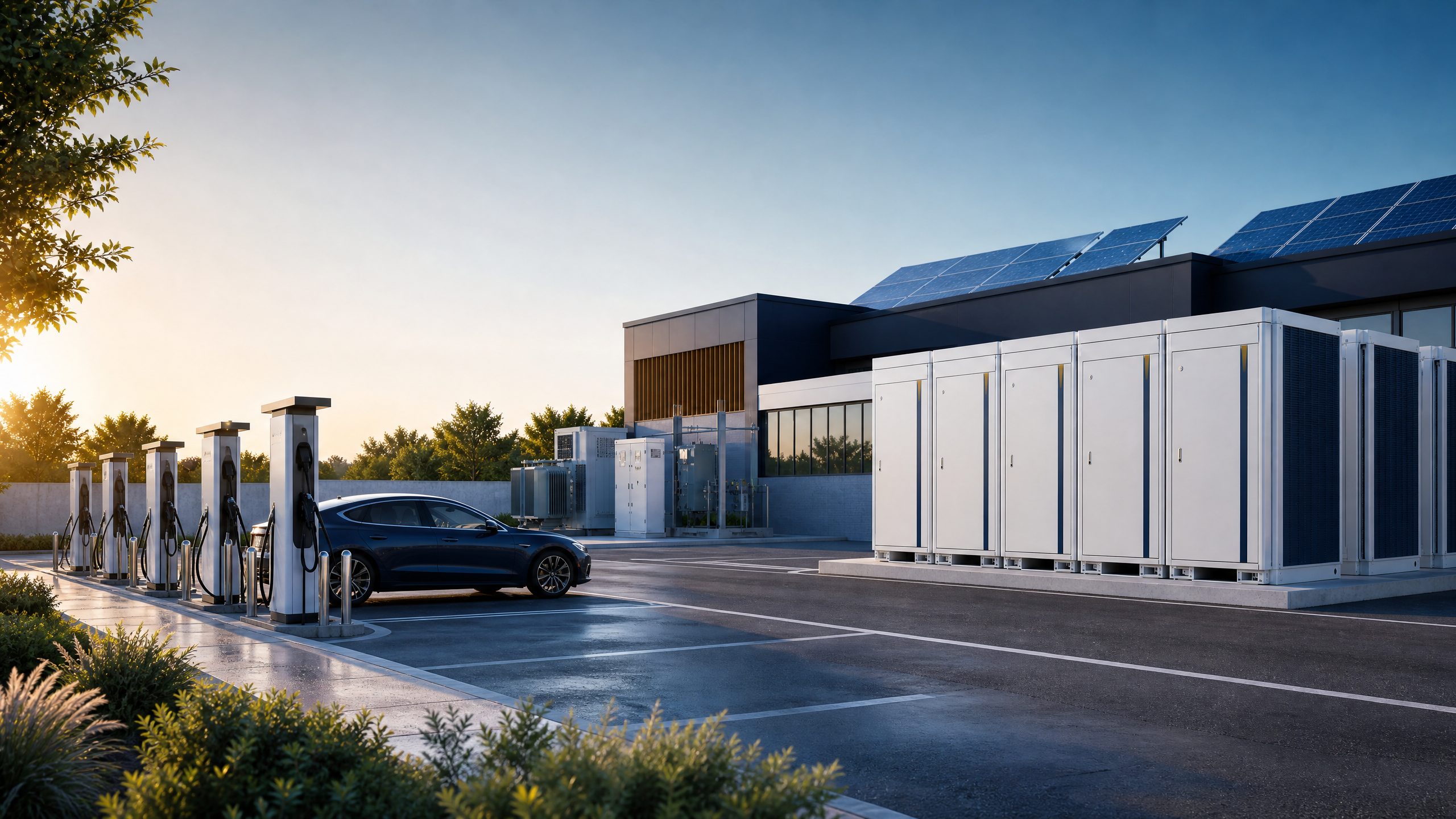
Why EV charging creates a difficult commercial load profile
The energy consumed by an EV charger is not the only design concern. When that energy is consumed, how many chargers operate concurrently, and how quickly drivers expect to leave can determine the required electrical infrastructure.
A depot may connect many vehicles overnight, while a motorway or fleet hub may experience concentrated arrivals during a narrow operating window. At a retail, workplace, logistics, or hospitality site, charging demand is layered on top of refrigeration, HVAC, lighting, production, and other building loads. If several 150 kW or higher chargers ramp together, the coincident load can be much higher than the site’s normal baseload.
The IEA classifies public chargers above 22 kW and up to 150 kW as fast, and chargers at 150 kW or above as ultra-fast. Its 2025 analysis reports that the global stock of fast chargers reached about 2 million in 2024, while ultra-fast chargers grew by more than 50% that year.1 This expansion increases the value of planning for power quality, connection capacity, and controllability—not simply installing more charger outlets.
The grid-connection constraint
A utility connection is generally limited by available network capacity, transformer and switchgear ratings, protection settings, local planning conditions, and the commercial terms of the connection. A site may have enough annual electricity consumption capacity but still lack enough instantaneous power for simultaneous fast charging.
A larger connection can solve the electrical bottleneck, but it may involve reinforcement, civil works, long approval cycles, or a higher fixed capacity charge. It may also leave the site with an oversized connection that is used only during occasional traffic peaks. A BESS can act as a controllable buffer between the grid connection and the chargers, subject to the utility’s approval and the limits of the system design.
The IEA notes that EV impacts depend on power and energy requirements, the grid being used, charging simultaneity, vehicle segments, user preferences, and local mobility patterns. It also recommends managed charging over unmanaged charging where practical.2 These principles apply directly to commercial charging projects.
How EV charging energy storage works
An EV charging BESS typically includes battery modules, a battery management system, power conversion equipment, an energy management system, protection and switchgear, thermal management, communications, and an enclosure or other installation arrangement. The exact architecture depends on site conditions and the required operating modes.
In a basic peak-shaving sequence, the BESS charges during a low-demand period or when renewable generation is available. The energy management system monitors the site’s grid import and the combined charger load. When the predicted or measured load approaches a configured import limit, the BESS discharges to supply part of the charging demand. When the event ends, it can recharge within the selected tariff or operating window.
The battery does not necessarily replace grid power. More often, it supplements a deliberately limited grid connection so that the chargers can provide higher short-duration output without forcing the entire site connection to match the theoretical maximum charger load. The battery power rating determines how much instantaneous support is available; usable energy determines how long that support can last. Both must be sized against the charging profile.
Peak shaving, load balancing, and demand management
These terms overlap, but they describe different design objectives.
| Function | What the controller manages | Commercial purpose | Câu hỏi điển hình về thiết kế |
|---|---|---|---|
| EV charging peak shaving | The site’s maximum grid import during charging events | Reduce demand-related costs or stay within a connection limit | What import ceiling must not be exceeded? |
| Load balancing EV chargers | Power allocation among chargers and vehicles | Serve more vehicles while avoiding simultaneous maximum output | Which vehicles require priority, and by when? |
| Demand management | Site load, tariffs, schedules, and operating constraints | Coordinate charging with the building and utility price signals | When should charging, battery operation, or curtailment occur? |
| Fast-charging support | Short-duration battery discharge to raise available charger power | Deliver a better charging experience where the grid is constrained | How long and how often must the BESS support high power? |
Giảm tải đỉnh
Peak shaving uses a control threshold. For example, if a facility wants to hold grid import below an agreed limit, the BESS discharges whenever the combined building and charger load would exceed that limit. The threshold should account for measurement delay, forecast error, battery state of charge, reserve requirements, and the response characteristics of the chargers and power conversion system.
Peak shaving is not automatically the same as reducing total energy consumption. It changes the timing and source of power. The commercial value depends on the tariff structure, demand calculation interval, battery losses, operating limits, and the cost of cycling. A financial model should therefore compare the full operating cost of the BESS with the avoided capacity, demand, or connection costs rather than assume every discharged kilowatt-hour is free.
Load balancing
Load balancing EV chargers is a control strategy for distributing available power. Instead of allowing every charger to request its maximum rating, the site controller can allocate power based on vehicle state of charge, departure time, fleet priority, minimum service levels, and the site import limit. A BESS adds another controllable resource: the controller can combine grid power, battery power, solar generation where available, and charger setpoints.
For a fleet depot, this can protect a departure schedule. For a public site, it can reduce the chance that one vehicle’s session causes all other sessions to be throttled. The desired outcome is not always maximum instantaneous output; it is often the highest useful throughput within electrical and commercial constraints.
Demand management and tariffs
Tariffs can influence the best operating schedule. Time-of-use prices may encourage off-peak charging, while demand charges may be based on the highest average import over a defined interval. Some sites may also face contracted-capacity limits, export restrictions, or dynamic utility signals. The energy management system should reflect the actual tariff and settlement rules rather than use a generic peak/off-peak assumption.
The IEA identifies tariff design, contracts, and markets for flexibility as tools that can reward managed charging and recommends valuing flexibility where it provides system benefits.2 For a commercial owner, that means the business case should consider both direct savings and the operational value of keeping chargers available during constrained periods.
Illustrative before-and-after load profile
The following table is a constructed example for explanation, not measured project data or a DAXIN customer result. It assumes a site with a fixed grid-import target and a BESS that supplies the difference during the charging peak. Actual performance depends on charger controls, battery state of charge, conversion losses, response time, and the site’s measured load.
| 30-minute interval | Building load (illustrative) | Charger demand before BESS (illustrative) | Grid import before BESS | Battery support after BESS | Grid import after BESS |
|---|---|---|---|---|---|
| 08:00–08:30 | 180 kW | 120 kW | 300 kW | 0 kW | 300 kW |
| 08:30–09:00 | 190 kW | 260 kW | 450 kW | 100 kW | 350 kW |
| 09:00–09:30 | 210 kW | 390 kW | 600 kW | 250 kW | 350 kW |
| 09:30–10:00 | 220 kW | 330 kW | 550 kW | 200 kW | 350 kW |
| 10:00–10:30 | 200 kW | 180 kW | 380 kW | 0 kW | 380 kW |
In this illustrative profile, the control objective is to cap grid import at approximately 350 kW during the sharpest charging intervals. The table does not state that a real system will achieve that result. It demonstrates the design logic: the battery is idle when the load is below the threshold and discharges when the combined load rises above it.
How to size a fast charging BESS
A practical design starts with a load study rather than a preferred battery size. The following inputs are especially important.
| Dữ liệu đầu vào | Why it affects the design |
|---|---|
| Site traffic | Arrival volumes, queue patterns, seasonality, and peak-hour concentration shape the probability of simultaneous charging. |
| Charger ratings and concurrency | Nameplate power is not the same as actual coincident power; connector count, sharing logic, and session behavior matter. |
| Dwell time and service promise | Short dwell times require higher power or more available energy per vehicle; longer stays allow managed charging. |
| Tariffs and demand rules | Capacity charges, demand intervals, time-of-use prices, and export rules determine operating value. |
| Grid capacity | The permitted import limit sets the power that must be supplied by the grid, managed at the chargers, or supplemented by storage. |
| Operating reserve | A reserve policy protects availability for later arrivals and reduces the risk of an empty battery during the busiest window. |
| Expansion plan | Future chargers, solar, fleet electrification, or building loads may change the required power and energy envelope. |
A useful first calculation is illustrative only: if chargers request 600 kW while the site’s permitted import is 350 kW, the instantaneous support requirement is approximately 250 kW before considering reserves and losses. If that support is required for one hour, the nominal energy need would be approximately 250 kWh; a real design would increase or otherwise adjust this figure for usable state-of-charge range, efficiency, degradation, reserve, and the expected event duration. If the event lasts 15 minutes, the energy requirement is lower but the power-conversion rating may remain decisive.
A BESS should not be selected from power alone. A high-power, short-duration system may suit a highway stop with brief traffic surges, while a depot may need sustained support across a departure window. The design may also combine charger-side power sharing with storage, allowing a smaller BESS to deliver the required service at lower cycling intensity.
Difference: BESS peak shaving versus charger-only load management
Charger management and battery storage are complementary, not interchangeable.
| Approach | Strength | Limitation |
|---|---|---|
| Charger-only management | Requires no battery and can reduce coincident demand through scheduling or power sharing | May reduce charging speed or throughput when the grid limit is reached |
| BESS with charger management | Can preserve higher short-duration charging output while enforcing a grid-import limit | Adds capital cost, conversion losses, maintenance, controls integration, and safety requirements |
| Larger grid connection | Provides more firm import capacity | May require reinforcement, higher connection charges, and a longer development path |
| Hybrid approach | Coordinates connection capacity, charger controls, storage, and potentially solar | Requires integrated design, clear control priorities, and robust commissioning |
The right option depends on traffic economics, service commitments, utility conditions, available space, and the cost of alternatives. DAXIN ENERGY’s solutions and project experience can be reviewed through the DAXIN ENERGY solutions page và projects page; project-specific suitability still requires engineering assessment.
Project-data checklist for an EV charging energy storage assessment
Before requesting a concept design, assemble the following information:
- The site address, utility, voltage level, single-line diagram, transformer rating, protection information, and current import/export limits.
- At least several weeks of interval meter data, preferably covering representative weekdays, weekends, weather conditions, and seasonal peaks.
- Charger make and model, rated power, connector count, power-sharing behavior, communications protocol, planned expansion, and actual session records if available.
- Traffic forecasts, arrival and departure distributions, vehicle classes, dwell times, queue tolerance, and the minimum charging service the operator wants to guarantee.
- Building load categories, operating schedules, onsite generation, backup systems, and other flexible loads that may interact with the charging system.
- Electricity bills, tariff schedules, demand-charge definitions, contracted-capacity terms, penalties, and any demand-response or flexibility opportunities.
- Space, access, environmental conditions, fire-safety requirements, noise limits, drainage, cable routes, and restrictions on construction or maintenance.
- Commercial priorities, including grid-upgrade avoidance, charging throughput, resilience, renewable integration, operating-cost reduction, or future site expansion.
This data enables a more credible comparison of storage power, usable energy, controls, connection strategy, and lifecycle economics. It also reduces the risk of sizing a battery for a theoretical charger peak that rarely occurs—or undersizing it against a recurring traffic pattern.
Conclusion: make charging capacity more flexible
EV charging energy storage can help commercial sites manage the gap between high charger ratings and limited grid capacity. Through peak shaving, load balancing, and tariff-aware demand management, a BESS may support fast charging while keeping grid import within a defined operating envelope. The strongest designs begin with measured load and traffic data, then coordinate the battery, chargers, utility connection, and site loads through a clear control strategy.
DAXIN ENERGY can be considered as part of that early technical conversation. To discuss a project’s operating profile and required information without committing to a technology or specification prematurely, use the DAXIN ENERGY contact page.
Tài liệu tham khảo
Article note: Illustrative calculations and load profiles in this article are explanatory examples only. They are not measured project results, quotations, product specifications, certifications, prices, lead times, or guarantees.