











ระบบพลังงานแสงอาทิตย์พร้อมระบบเก็บพลังงานสำหรับอาคารเชิงพาณิชย์: การใช้พลังงานเอง การสำรองพลังงาน และการสนับสนุนระบบไฟฟ้า
Commercial buildings often generate solar electricity at the same time that their load profile is changing. Offices may have strong daytime demand, while warehouses, retail sites, schools, hotels, and light-industrial facilities can experience midday surplus and evening or overnight consumption. Solar plus storage for commercial buildings connects photovoltaic generation, battery capacity, power conversion, and controls so the site can use more of its own solar energy and operate with greater flexibility.
The right design is not simply “more panels and a larger battery.” It begins with the building’s interval load data, operating priorities, electrical infrastructure, tariff structure, export rules, and resilience requirements. A well-configured PV plus battery system can support solar self-consumption, limit exports, shift energy into higher-value periods, provide selected-load backup, reduce diesel generator runtime, and respond to grid signals when regulations and commercial programmes allow.
What does solar plus storage mean for a commercial building?
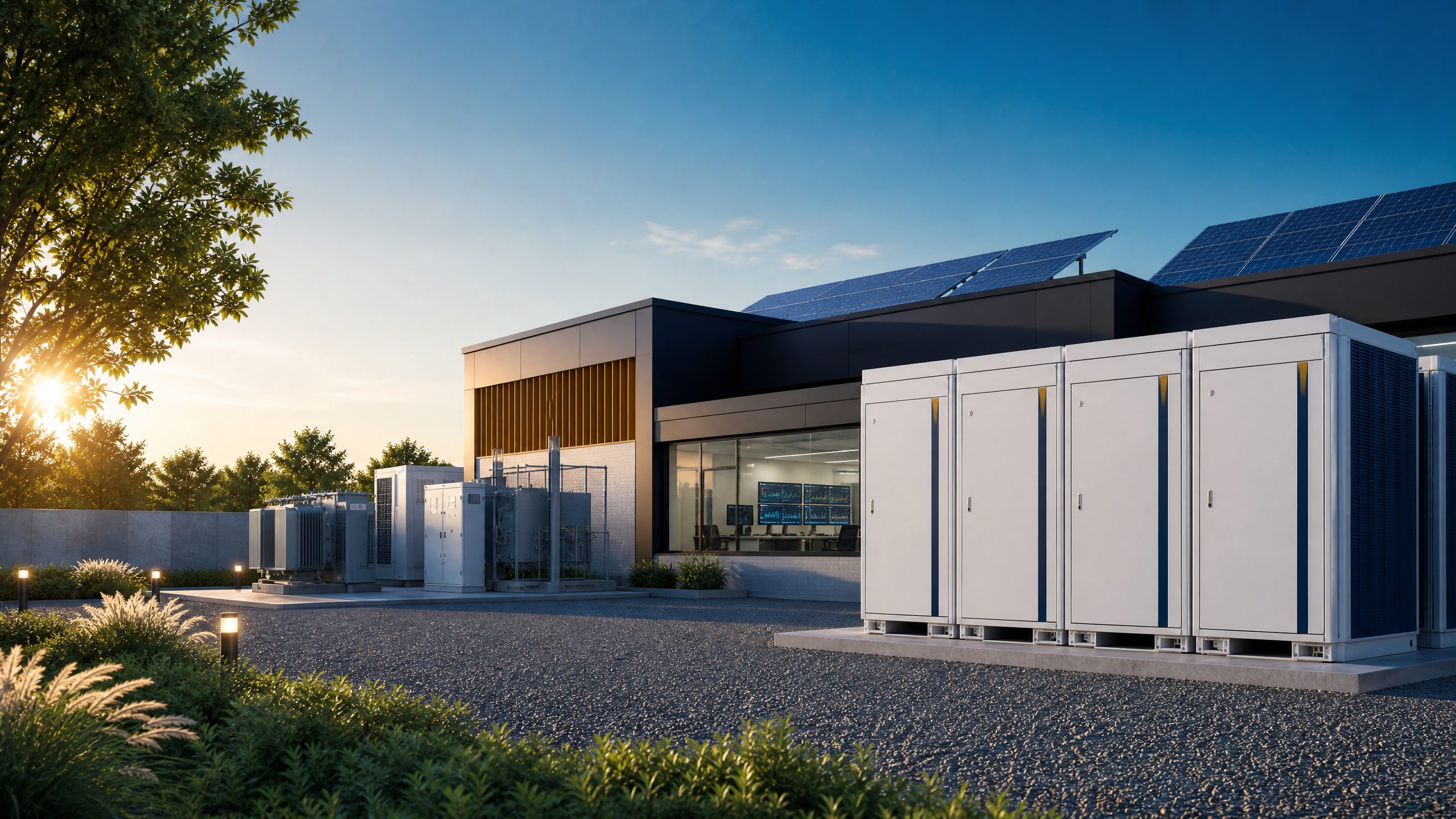
A commercial solar-plus-storage system combines a PV array with battery energy storage and an inverter or power-conversion system. An energy management system (EMS) monitors PV output, building demand, battery state of charge, grid conditions, and operating rules. It then determines when the battery should charge, discharge, remain reserved for backup, or provide a controlled response.
This architecture matters because solar generation is variable and often does not perfectly match a building’s demand. The International Energy Agency notes that a substantial part of building-level PV can be generated when it is not needed, and identifies demand response and storage as ways to increase self-consumption.1 The same analysis describes buildings as an emerging source of flexibility through storage, smart controls, and responsive loads.1
Core operating benefits
1. Increase solar self-consumption
Solar self-consumption is the share of on-site PV production consumed by the building rather than exported to the grid. During a sunny period, a commercial site may serve its active loads directly from PV. If generation exceeds instantaneous demand, the EMS can send the surplus to the battery, subject to battery limits and the project’s operating strategy. Later, the stored energy can support the building when PV output falls.
This approach can be valuable where exported electricity receives a lower value than on-site consumption, where export capacity is constrained, or where the owner wants to increase the practical use of its renewable generation. Self-consumption should be measured from time-series data, not estimated from annual PV production alone.
2. Manage export limitation
Some sites cannot export their full PV output because of an interconnection limit, local network conditions, or a commercial decision to avoid reverse-power flow. Export limitation uses metering and controls to keep grid import or export within a defined boundary. The EMS may reduce PV output, increase flexible load, or charge the battery when excess generation would otherwise exceed the permitted export level.
Export control must be engineered as part of the complete electrical system. Meter location, communications reliability, inverter response, protection coordination, and the utility’s requirements all matter. A battery is not automatically an export-limitation solution; it must be integrated with suitable measurement and control logic.
3. Time-shift solar energy
Time shifting stores energy when PV production is available and discharges it later. For example, a building with a midday solar surplus and an evening operating period may use the battery to move part of that energy into the later load window. A battery can also charge from the grid under a permitted tariff strategy and discharge during a higher-cost period, although the economic case depends on tariff rules, round-trip losses, battery degradation, and operating constraints.
Any calculation should be clearly treated as illustrative. For instance, if a hypothetical system stores 500 kWh and delivers 450 kWh after assumed conversion losses, the 450 kWh figure is an example of usable delivered energy—not a promised result. Actual performance depends on equipment, temperature, dispatch, state-of-charge limits, ageing, and site conditions.
4. Provide solar backup power
Solar backup power can keep selected critical loads operating during a grid outage when the system is designed for backup operation. Critical loads might include refrigeration, security, network equipment, emergency lighting, process controls, or communications. Backup design normally requires load segregation, an appropriate transfer or islanding arrangement, short-circuit and protection review, and a clearly defined autonomy target.
Backup should not be described only by battery energy capacity. Power capacity determines which loads can start and run at the same time, while energy capacity influences how long they can be supported. The PV array may recharge the battery during an outage if the inverter and controls support safe islanded operation and site conditions permit. Backup availability may also require maintaining a reserve state of charge during normal operation.
5. Reduce diesel generator use
In locations with weak grids, frequent outages, or high generator dependence, a battery can reduce diesel generator starts, idle operation, and short-duration load fluctuations. The battery may serve transient loads, smooth demand, and allow the generator to run closer to an efficient operating range. When paired with PV, the system can reduce the amount of diesel energy needed during suitable solar conditions.
The result depends on dispatch rules, generator compatibility, minimum loading requirements, fuel logistics, and the site’s outage profile. DAXIN ENERGY should not claim a specific fuel reduction without a measured baseline and a project-specific model.
6. Support the grid
Where market rules and interconnection agreements allow, a commercial battery can provide grid-support functions such as controlled import reduction, ramp-rate management, reactive-power support, or participation in demand-response programmes. Smart inverters and real-time controls can help coordinate the site’s response; the IEA identifies smart inverters, demand-side response, and management systems as enabling technologies for integrating variable renewable generation.1
Grid support is not a universal revenue stream. Eligibility, metering, response times, dispatch authority, compensation, and technical requirements vary by jurisdiction. The system should be designed first around the owner’s operational priorities, then evaluated for additional grid services.
PV-only vs battery-only vs PV-plus-storage
The difference between these architectures is primarily about energy source, flexibility, resilience, and control complexity.
| Architecture | Main function | Strengths | Limitations | Typical commercial use case |
|---|---|---|---|---|
| PV-only | Generates electricity when solar resource is available | Lower system complexity; direct renewable generation; can reduce daytime grid imports | Limited ability to use midday surplus later; may require export control or curtailment; normally no battery-based backup | Buildings with strong daytime loads and acceptable export arrangements |
| Battery-only | Stores electricity from the grid or another source and discharges later | Can support time shifting, peak management, backup, and selected grid services | Does not create renewable energy; charging source and tariff rules affect value; requires careful cycling strategy | Sites focused on resilience, demand management, or tariff optimisation |
| PV-plus-storage | Coordinates PV, battery, grid, loads, and EMS | Higher operational flexibility; improves solar utilisation; can combine self-consumption, export control, time shifting, and backup | More complex design, controls, protection, commissioning, and financial evaluation | Commercial buildings with surplus PV, resilience needs, constrained export, or multiple operating objectives |
What project data is needed for design?
A credible design begins with data that reflects actual operation. At minimum, the project team should request 12 months of interval electricity demand, preferably at 15-minute or finer resolution where available. The data should show import, export, peak demand, operating hours, weekends, holidays, seasonal variation, and unusual shutdowns.
The PV assessment should include available roof or ground area, shading, orientation, tilt, structural constraints, electrical connection point, expected PV capacity, and any existing inverter information. Site drawings should identify the main switchboard, transformers, critical-load panels, generator connection, protection devices, metering points, and cable routes.
Commercial assumptions are equally important. The design team needs the tariff schedule, demand charges, export compensation, export limit, interconnection conditions, outage history, generator fuel and operating data, and any demand-response or ancillary-service rules. The owner should also define priorities: maximum solar self-consumption, bill management, backup duration, peak-power support, diesel reduction, emissions reporting, or grid participation.
| Data category | Examples of information to provide | Why it affects design |
|---|---|---|
| Electrical load | Interval kW, kWh, power factor, peaks, critical loads | Determines inverter power, battery energy, and load segregation |
| PV resource | Roof area, shading, orientation, proposed DC capacity | Determines generation profile and surplus periods |
| Grid connection | Import/export limits, voltage, transformer, protection, metering | Determines interconnection and export-control requirements |
| Tariff and market | Time-of-use prices, demand charges, export value, programme rules | Determines dispatch priorities and business case assumptions |
| Resilience | Critical loads, outage frequency, required autonomy, generator details | Determines backup topology, reserve state of charge, and controls |
| Operating environment | Temperature, humidity, dust, flood/fire constraints, access | Influences enclosure, HVAC, safety, siting, and maintenance planning |
| Owner objectives | Self-consumption, peak control, backup, diesel reduction, grid services | Establishes the control hierarchy and evaluation criteria |
How the EMS coordinates the system
The EMS is the operating layer that turns connected equipment into a coordinated asset. It can prioritise direct PV consumption, charge the battery from excess PV, maintain a backup reserve, enforce an export limit, discharge against a demand threshold, and respond to authorised grid signals. The control hierarchy should be documented before procurement so that commercial priorities do not conflict.
A practical control sequence might begin with serving live building loads from PV. Excess PV then charges the battery until a defined state-of-charge limit is reached. If the battery is full and export is restricted, the EMS can curtail PV or activate an approved flexible load. During a scheduled high-demand window, it may discharge within the agreed power limit while preserving the reserve needed for backup. During an outage, the system transitions to the defined critical-load mode rather than attempting to supply every building circuit.
Interoperability and data quality deserve particular attention. The IEA highlights the need for interoperable systems, reliable energy data, and automated controls that maximise renewable use without creating grid problems.1 Metering, communications, cybersecurity, alarm handling, and manual override procedures should therefore be included in the design review—not left to commissioning.
A practical design and procurement pathway
Start with a measured baseline and establish the building’s operational priorities. Next, model several PV and battery sizes against the actual load profile, including energy losses, reserve capacity, export constraints, degradation assumptions, and outage scenarios. Compare the results using transparent indicators such as solar self-consumption, grid import reduction, peak demand, curtailed PV, backup power, and expected battery throughput.
Then review the physical design: equipment location, ventilation or thermal management, fire and safety provisions, access, maintainability, noise, protection coordination, and utility approval. A design that performs well in a spreadsheet but cannot be safely integrated into the switchboard is not a complete project design.
DAXIN ENERGY’s solutions page can serve as a starting point for discussing system architecture, while the products page provides a route to review relevant product categories. For a project-specific assessment, owners and engineering teams can share their load profile and objectives through the DAXIN inquiry page.
Conclusion: design around the building, not just the battery
Solar plus storage for commercial buildings is most effective when it is treated as an integrated energy-management project. PV can supply live loads; the battery can move energy across time; backup controls can protect selected circuits; and the EMS can enforce operating priorities while supporting grid-compatible flexibility. The value depends on the building’s data, tariff, export rules, outage requirements, and electrical context.
For commercial decision-makers, the next step is not to select a battery by nameplate capacity alone. It is to define the load, the PV profile, the critical circuits, the grid boundary, and the control objectives. With those inputs, DAXIN ENERGY can help evaluate an appropriate commercial solar battery storage architecture without relying on unsupported savings claims or generic sizing rules.