












Armazenamento comercial de energia em baterias: como a redução de picos melhora o controle dos custos de energia
Commercial and industrial electricity bills are often shaped by more than total kilowatt-hours. In many tariff structures, a brief interval of high demand can influence a monthly demand charge, even when the facility’s average consumption is much lower. Commercial battery energy storage gives site operators a controllable way to reduce those short-lived peaks, coordinate flexible loads, and make better use of on-site renewable generation.
For a C&I facility, the business case is not simply “install a battery and save money.” It depends on the site’s interval load profile, utility tariff, operating schedule, interconnection limits, battery operating strategy, and the value of resilience. DAXIN ENERGY positions its commercial and industrial ESS solutions around applications including peak shaving, demand response, backup power, and solar-plus-storage integration.1 A site-specific assessment is therefore essential before any savings claim or system-size recommendation is made.
What Is Peak Shaving?
Peak shaving is the controlled use of a battery to reduce the amount of power a facility draws from the grid during selected high-demand intervals. When the building load rises above a configured threshold, the battery discharges to supply part of the load. When demand falls, or when energy prices and operating conditions are favorable, the system can recharge.
A simple representation is:
Grid import = facility load − battery discharge + battery charging
If a facility reaches a 1,000 kW demand spike and a battery discharges 200 kW at that moment, the grid sees approximately 800 kW, subject to the system’s controls, response time, state of charge, and metering arrangement. The purpose is not necessarily to eliminate every peak. It is to manage the peaks that matter under the applicable tariff and operating plan.
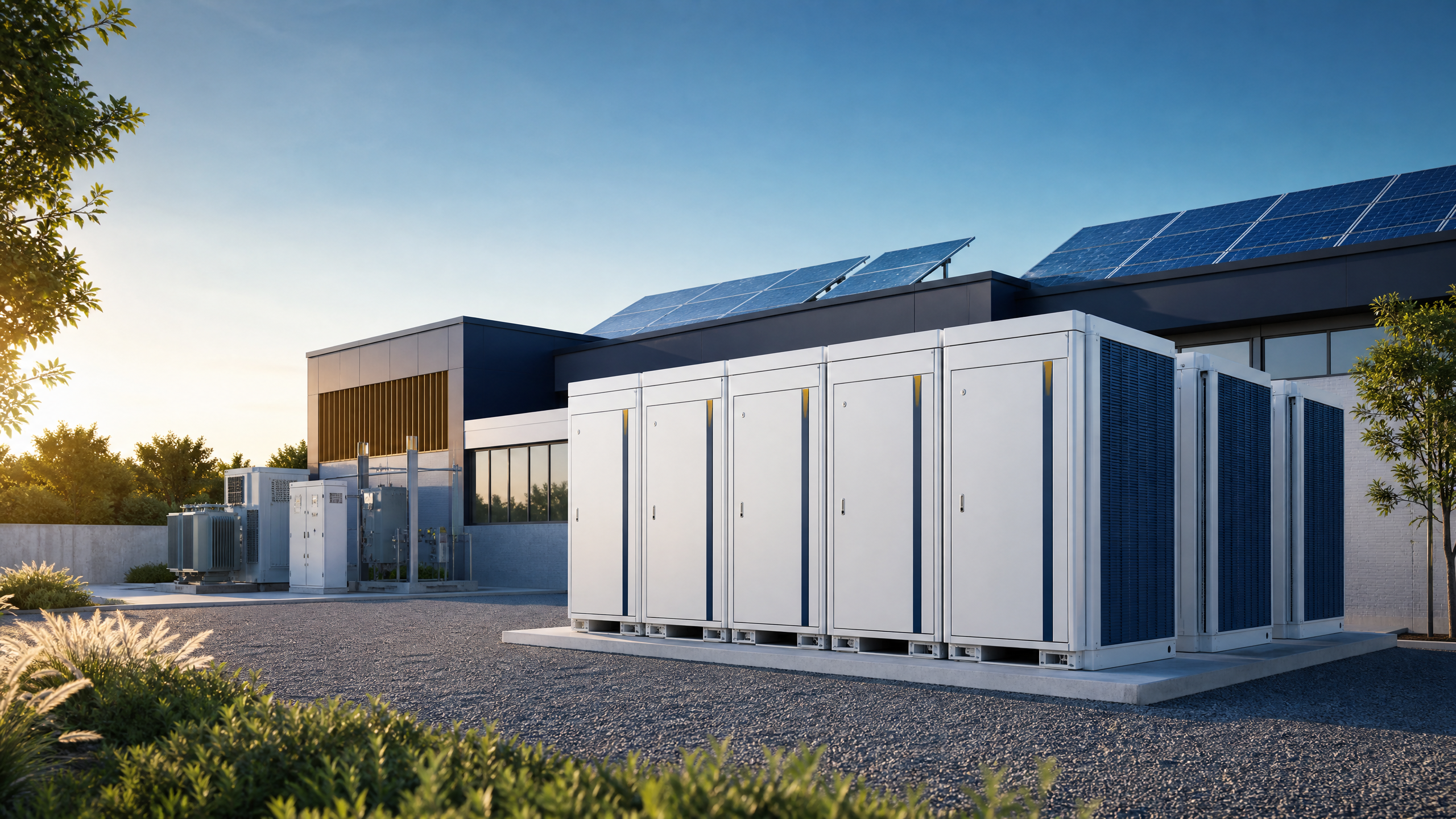
A peak shaving battery normally combines battery racks, a power conversion system, energy management controls, protection equipment, monitoring, and thermal management. DAXIN’s product range includes liquid-cooled outdoor energy storage cabinets presented for industrial and commercial ESS applications, including the X-CUBE 215 and X-CUBE 261 product categories.2 The exact configuration, usable energy, power rating, controls, and site suitability must be confirmed against the project design rather than inferred from a product family name.
Why Demand Charges Matter to Commercial Facilities
Energy charges are generally linked to the amount of electricity consumed over a billing period. Demand charges are linked to the highest measured power demand, or to a tariff-defined demand calculation, during a specified interval. The interval may be short, and the tariff rules vary by utility, customer class, season, and location.
This distinction changes the storage question. A facility with moderate annual energy consumption can still have an expensive bill if a chiller start, production shift, electric vehicle charging event, or simultaneous process loads create a high monthly peak. Conversely, a facility with a flat load profile may have fewer opportunities for peak shaving even if its total consumption is substantial.
The first analytical task is to map the site’s load profile. Useful inputs typically include 15-minute or 5-minute interval demand data, at least 12 months of bills, the tariff’s demand definitions, operating calendars, planned electrification, solar output, and any export restrictions. The analysis should identify not only the highest peak but also how often high-demand events occur, how long they last, whether they are predictable, and whether they cluster at times when the battery can be charged.
| Load-profile question | Why it matters for a commercial battery storage system |
|---|---|
| How high are the monthly and seasonal peaks? | Establishes the potential demand-reduction target. |
| How long do peaks last? | Helps determine required power and usable energy. |
| Are peaks predictable? | Supports reliable dispatch and state-of-charge planning. |
| Do peaks coincide with solar production? | Determines whether solar can charge the battery directly or reduce grid import. |
| Are there export or interconnection limits? | Influences controls, operating modes, and project economics. |
Without these data, it is not responsible to promise a percentage reduction, annual savings figure, or payback period. A battery can reduce a well-defined peak, but it cannot guarantee savings if the tariff does not reward the behavior, if the peak is longer than the available energy, or if the system is not reserved with enough state of charge.
Commercial Battery Storage System Strategies Compared
Peak shaving is one operating strategy among several. A commercial battery storage system may be designed for one primary value stream or coordinated across multiple applications. The priority should be established before controls are configured, because the battery cannot provide unlimited power and energy to every service at the same time.
| Strategy | Operating principle | Primary value | Main design consideration | Typical fit |
|---|---|---|---|---|
| Peak shaving | Discharge when site demand approaches a target threshold. | Demand charge management. | Peak duration, power requirement, tariff measurement interval, and state-of-charge reserve. | Manufacturing, warehouses, commercial buildings, and sites with sharp demand spikes. |
| Time-of-use arbitrage | Charge in lower-price periods and discharge during higher-price periods. | Energy cost optimization. | Time-of-use spread, round-trip losses, cycling cost, and tariff rules. | Facilities with predictable schedules and meaningful price differentials. |
| Backup power | Maintain stored energy for critical loads during an outage. | Continuity and resilience. | Critical-load definition, transfer equipment, islanding controls, duration, and recharge plan. | Sites where downtime, data loss, or process interruption is costly. |
| Grid services | Respond to an external signal or market program. | Flexibility revenue or system support. | Program eligibility, telemetry, dispatch obligations, and availability requirements. | Sites participating in demand response or approved flexibility programs. |
The important difference is that peak shaving is measured against the facility’s grid import, whereas backup power is measured against continuity requirements. A system optimized for daily demand charge management may not be able to discharge fully during an outage if it has already used its energy earlier in the day. A project brief should therefore define whether resilience is a secondary benefit, a contractual requirement, or the main reason for storage.
How Demand Response Extends Peak Shaving
Demand response changes electricity use in response to grid conditions, utility signals, or price events. A battery can participate by reducing grid import when the system receives a dispatch request, while a facility may also adjust HVAC, refrigeration, pumping, charging, or production schedules.
For a C&I BESS, demand response can complement local peak shaving. Local controls protect the facility’s own demand target; an external demand-response program may call for a reduction at a different time. The energy management system must decide whether to respond, how much capacity is available, and what state-of-charge reserve should be preserved for site priorities.
The IEA describes demand flexibility as a way to shift or adjust electricity use in response to system conditions, improving the utilization of generation and network assets.3 This is relevant to commercial buyers because a battery is more valuable when it can be coordinated with flexible loads rather than operated as an isolated asset. However, program availability, compensation, metering, and technical requirements are location-specific. They should be verified with the utility, aggregator, or energy-service provider.
Backup Value and Renewable Integration
Peak shaving is often the first economic use case, but a properly designed system can also support resilience. During an outage, the system may supply designated critical loads if the site has the required transfer, protection, and islanding architecture. Critical loads should be separated from nonessential loads through an engineering process; “backup for the whole facility” is not a default assumption.
Solar integration adds another layer of value. A battery can absorb surplus PV output that would otherwise be curtailed or exported at a lower value, then discharge later when the site load rises or grid electricity is more expensive. Solar-plus-storage can also help align renewable generation with operational demand. The IEA identifies distributed resources such as rooftop solar and other flexibility sources as increasingly important to how grids operate.4
Liquid-cooled outdoor cabinets are relevant where a project calls for an integrated outdoor enclosure and controlled thermal environment. DAXIN’s published product listings identify liquid-cooled outdoor cabinet options within its industrial and commercial energy storage portfolio.2 Selection should still account for the site climate, placement, clearances, fire-safety design, service access, noise requirements, communications, and local approval process. Product category language is not a substitute for a project-specific specification.
A Simple ROI Framework for Commercial Energy Cost Optimization
A practical screening model should separate identifiable benefits from assumptions. One illustrative annual value equation is:
Annual storage value = demand-charge reduction + energy-arbitrage value + demand-response value + avoided outage cost − charging cost − losses − operating and maintenance costs
For demand-charge management, a simplified illustrative calculation is:
Illustrative annual demand value = average monthly peak reduction × demand-charge rate × 12 months
For example, if a site’s measured profile supports an average reduction of 150 kW and the applicable demand charge is assumed to be USD 12 per kW-month, the gross illustrative demand value would be 150 × 12 × 12 = USD 21,600 per year. This is only a mathematical example, not a DAXIN quotation, forecast, or promised result. It does not include battery degradation, conversion losses, controls, installation, financing, maintenance, tariff changes, or the cost of keeping reserve energy for backup.
A more complete project screen should compare several scenarios: no storage, peak shaving only, peak shaving plus time-of-use arbitrage, and peak shaving with a defined backup reserve. The model should test different battery power and energy sizes against actual interval data. It should also apply a dispatch constraint so the battery is not credited with more energy than it can realistically deliver after charging losses and reserve requirements.
| ROI input | Recommended evidence or assumption |
|---|---|
| Demand-charge benefit | Utility tariff and interval-meter simulation. |
| Energy-arbitrage benefit | Time-of-use prices, operating schedule, and efficiency assumptions. |
| Backup value | Critical-load list, outage history, and quantified interruption cost. |
| Demand-response value | Confirmed program rules, availability, and dispatch compensation. |
| Total project cost | Vendor scope, electrical work, controls, permitting, and commissioning. |
| Risk sensitivity | Battery degradation, tariff changes, lower-than-expected peak frequency, and reserve constraints. |
The resulting outputs may include simple payback, net present value, internal rate of return, and sensitivity ranges. Commercial investigation should not stop at the most favorable case. A robust decision shows what happens if peak events are less frequent, the demand rate changes, or the battery must preserve energy for backup.
Planning Questions Before Selecting a C&I BESS
Buyers should ask whether the proposed system is being sized for power, energy, resilience, or a combined duty cycle. They should also confirm how the energy management system will receive meter data, how the peak threshold will be changed, what happens after an unexpected event, and who is responsible for commissioning and ongoing monitoring.
DAXIN’s solutions portfolio identifies commercial and industrial ESS use cases such as peak shaving, demand response, and backup power, while its products page organizes energy storage systems alongside other power products.1 For a project team, the next step is to provide the relevant load and tariff information so the system architecture can be evaluated on evidence rather than a generic savings promise.
Conclusion: Use the Load Profile to Turn Storage Into a Strategy
Commercial battery energy storage can improve energy cost control by reducing selected grid-demand peaks, shifting energy across tariff periods, supporting demand response, preserving backup capability, and increasing the usable value of solar generation. The strongest projects begin with the load profile and tariff—not with a preselected battery size.
DAXIN ENERGY’s commercial and industrial ESS positioning, including liquid-cooled outdoor cabinet options, gives buyers a starting point for discussing a site-specific architecture. To explore the right application and data requirements, review DAXIN’s commercial and industrial energy storage solutions, browse the energy storage product categories, or share project information through the DAXIN inquiry page. The goal is a technically defensible design whose operating strategy matches the facility’s tariff, load behavior, resilience priorities, and renewable resources.