












UPS untuk Pusat Data: Kepadatan Daya, Beban Kritis, dan Daya Tahan Baterai
Data centers are becoming more power-dense, more geographically concentrated, and more dependent on continuous digital operations. For an enterprise facility, colocation site, or AI-ready server room, a suitable UPS for data centers does more than provide a battery during an outage: it conditions incoming power, protects sensitive loads, coordinates with generators and switchgear, and creates the controlled time window needed for an orderly continuity strategy.
The International Energy Agency estimates that data centers consumed about 415 TWh of electricity globally in 2024, or approximately 1.5% of worldwide electricity use. It also projects that data-center consumption could reach about 945 TWh by 2030 in its base case, with AI-related accelerated servers a major contributor to growth.1 These figures do not prescribe one UPS architecture, but they do explain why power quality, rack density, thermal management, and storage planning deserve early engineering attention.
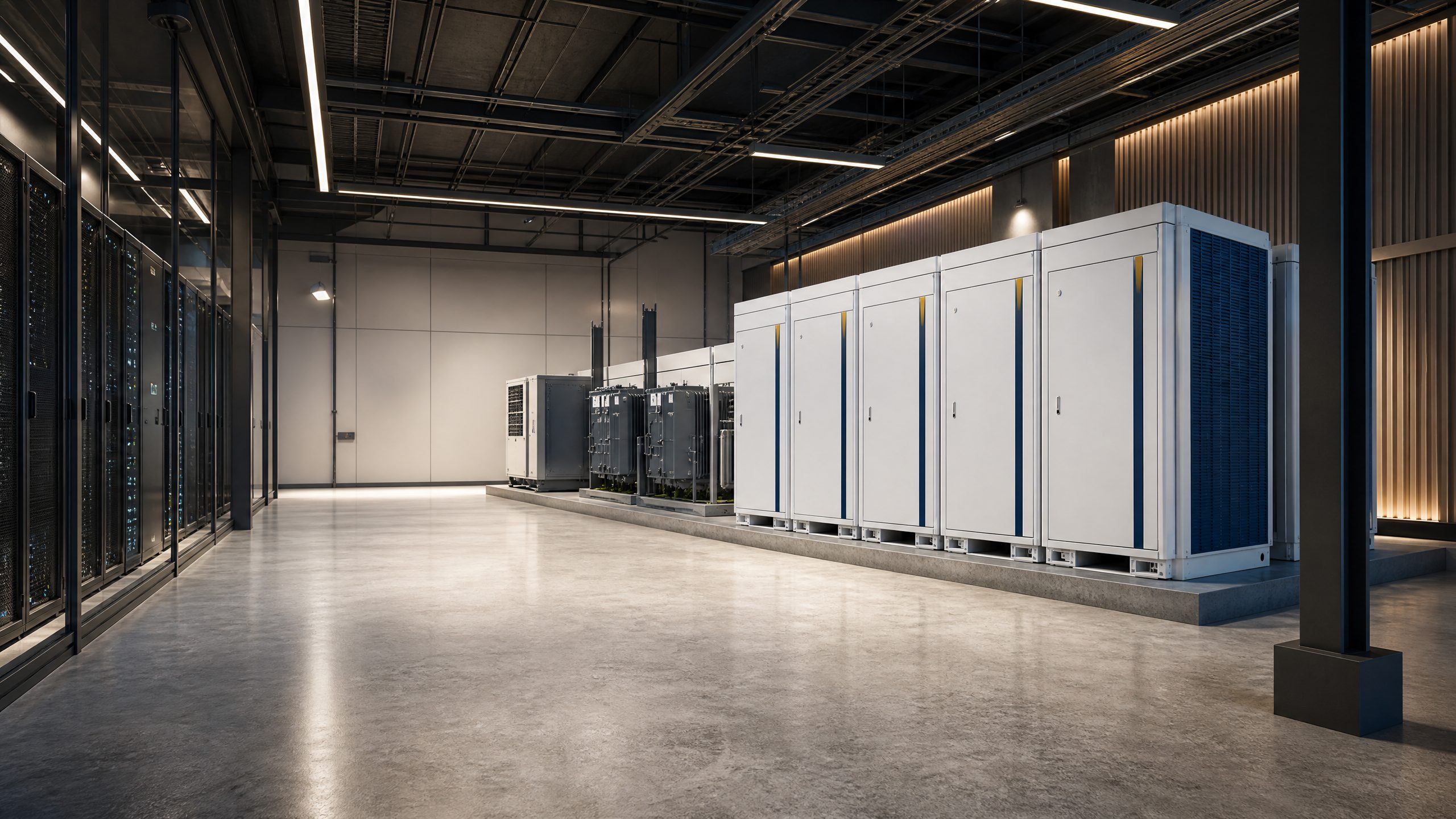
Why a data center UPS system is different from ordinary backup power
A data center contains several classes of electrical loads. IT servers, storage, network switches, security systems, controls, and selected cooling equipment may be designated as critical loads because interruption can cause service loss, corrupted processes, thermal risk, or an unacceptable restart sequence. Non-critical lighting, convenience outlets, and some mechanical loads may be shed or supplied through a different distribution path.
A UPS is therefore part of a coordinated power architecture rather than an isolated battery product. The design may include utility service, automatic transfer equipment, generators, distribution boards, power distribution units, rack-level protection, UPS modules, battery strings, monitoring, and a documented shutdown or ride-through sequence. The correct question is not simply “How many kilowatt-hours are in the battery?” It is “Which loads must remain powered, at what power quality, for how long, and under which failure scenario?”
DAXIN ENERGY presents data-center backup power as a solution area that includes UPS backup, battery storage, and critical load protection.2 That positioning is useful for projects where the UPS, battery system, and operating requirements must be considered together.
How an online double-conversion UPS protects critical loads
An online double-conversion UPS normally converts incoming AC power to DC and then converts DC back to tightly controlled AC for the protected load. The inverter supplies the load continuously, while the rectifier, battery interface, bypass path, and controls manage available energy and fault conditions.
This topology separates the load from many disturbances on the utility side. Voltage sags, swells, frequency variation, waveform distortion, and short interruptions can be managed without relying on a mechanical transfer event at the load. If the utility fails, the battery supports the DC bus and the inverter continues supplying the load. If an overload or internal fault occurs, a static or maintenance bypass may transfer the load to an alternate source, subject to the equipment’s operating limits and the site’s protection design.
That transfer behavior is a central reason online UPS technology is commonly evaluated for high-availability environments. A line-interactive or standby UPS may be appropriate in less demanding applications, but a data-center specification should examine output regulation, bypass behavior, fault clearing, short-circuit coordination, overload capability, maintenance procedures, and compatibility with the downstream equipment rather than choosing on topology name alone.
Transfer behavior: ride-through is not the same as long backup
The UPS battery is intended to bridge a power event. In a generator-backed facility, the battery may carry the critical load while the generator starts and the transfer equipment stabilizes. In a graceful-shutdown design, it may provide enough time for automated shutdown. In a longer-duration resilience design, it may work with a BESS or other generation assets.
Runtime is not a fixed attribute of a UPS cabinet. It depends on load in kW or kVA, power factor, battery chemistry and age, ambient temperature, discharge rate, battery configuration, inverter efficiency, and the minimum end voltage permitted by the design. Published runtime should therefore be interpreted at a stated load and operating condition. A project team should request a runtime curve or calculation basis rather than relying on a single headline number.
Power density and AI data center power planning
AI clusters can change the electrical profile of a data hall. Accelerated servers may create higher rack power, sharper load concentration, greater expansion uncertainty, and more demanding cooling requirements. The IEA notes that the rise of AI is accelerating deployment of high-performance accelerated servers and leading to greater power density in data centers.1
For a data center UPS system, power density affects more than the UPS nameplate. Engineers must review the available floor loading, battery cabinet footprint, busway or cable routes, maintenance clearances, fault-current levels, cooling capacity, harmonic performance, and the ability to expand without creating a single point of failure. A compact UPS can be valuable where space is constrained, but compactness must not compromise ventilation, service access, battery isolation, or safe working clearances.
Cooling deserves equal attention. UPS modules, power electronics, batteries, switchgear, and IT equipment all produce heat. An efficient facility may devote a smaller share of total electricity to cooling than a less-efficient enterprise facility; the IEA reports that cooling’s share varies widely by data-center type.1 The UPS room and battery environment should have a defined temperature range, airflow strategy, fire-safety approach, and monitoring plan. High ambient temperature can shorten battery life and change expected runtime, so thermal design is part of continuity design.
Redundancy: sizing for availability, maintenance, and growth
Redundancy is the deliberate provision of capacity or paths beyond the minimum operating requirement. Common arrangements include N, N+1, 2N, and distributed-redundant architectures, but the label alone does not prove resilience. The engineering review should identify what happens when one UPS module, battery string, distribution path, cooling unit, generator, or maintenance bypass is unavailable.
For example, an N+1 modular arrangement may allow one module to be removed while the remaining modules serve the design load, provided the controls, distribution, and maintenance procedures support that operating mode. A 2N arrangement may provide two independent power paths, but only if the downstream equipment has dual-cord capability or an appropriately designed automatic transfer mechanism. Redundancy also needs to account for future AI load growth: a system that is redundant at commissioning may lose its margin after rack additions.
| Design consideration | Questions for the project team | Mengapa hal ini penting |
|---|---|---|
| Kapasitas | What is the present and forecast critical load in kW and kVA? | Prevents undersizing and protects future headroom. |
| Topologi | Is online double conversion required for the load and site power quality? | Aligns protection level with equipment sensitivity and operating risk. |
| Redundancy | Is the target N, N+1, 2N, or distributed redundancy? | Defines failure and maintenance behavior. |
| Distribution | Are there independent A and B paths, and can the IT load use them? | Avoids a resilient UPS feeding a single downstream bottleneck. |
| Runtime | Is the objective generator bridging, graceful shutdown, or extended autonomy? | Determines battery and BESS scope. |
| Thermal environment | How are UPS and batteries cooled, monitored, and serviced? | Supports predictable performance and asset life. |
UPS battery runtime versus longer-duration BESS
UPS bridging and battery energy storage are related but different functions. The UPS is optimized for immediate continuity, power conditioning, control, and the protection of defined critical loads. A longer-duration BESS is typically evaluated as an energy asset: it can store more energy, support extended backup, interact with on-site generation or the grid, and potentially reduce peak demand when the project’s controls, interconnection, and commercial strategy allow it.
A BESS does not automatically replace a data-center UPS. Its inverter controls, transfer scheme, protection settings, response behavior, operating modes, and integration with the facility’s critical distribution must be engineered for the intended duty. Conversely, extending UPS battery strings may not be the most economical or operationally appropriate approach when the requirement is hours of backup, peak shaving, renewable integration, or broader site energy management.
The IEA describes battery storage as an important flexibility technology in power systems, particularly as variable renewable generation expands.3 That system-level role is distinct from the UPS’s immediate load-protection role, even though both use batteries and power electronics.
UPS versus BESS: key differences
| Atribut | UPS for data centers | Longer-duration BESS |
|---|---|---|
| Primary purpose | Protect critical loads and bridge short power interruptions. | Store and dispatch energy for extended backup, flexibility, or energy-management objectives. |
| Response objective | Maintain conditioned power with controlled transfer or ride-through behavior. | Respond according to a designed energy-management and backup control strategy. |
| Typical design question | How long until the generator is stable or the IT load shuts down safely? | How much energy and power are required over an extended operating period? |
| Load scope | Usually a defined critical-load bus or protected IT path. | May support selected facility loads, a microgrid, or an upstream electrical bus. |
| Power quality | Inverter regulation and bypass behavior are central specifications. | Power quality depends on inverter, controls, interconnection, and system architecture. |
| Operating profile | Often standby or short-duration emergency duty. | May cycle for peak shaving, renewable integration, or extended backup. |
| Integrasi | Closely coordinated with UPS distribution, generators, bypass, and IT loads. | Integrated with switchgear, generation, EMS, utility requirements, and site safety systems. |
| Maintenance focus | Battery health, UPS modules, bypass, alarms, cooling, and transfer tests. | Battery health, thermal management, EMS, inverter, fire protection, cycling, and interconnection controls. |
Monitoring, maintenance, and operational readiness
Monitoring should cover utility input, bypass status, inverter state, battery voltage and current, state of charge, alarms, temperature, communications, load level, and module availability. Where the project permits, alarms should feed a building-management, electrical-management, or data-center-infrastructure-management platform with clear escalation rules. Remote visibility is valuable, but it does not replace local inspection and a tested response procedure.
Maintenance planning should define battery inspection, torque and connection checks, firmware and control review, ventilation and cooling inspection, alarm verification, bypass operation, generator coordination, and load-bank or other approved testing. Battery age, temperature history, impedance or conductance trends, and actual discharge behavior should be reviewed against the required UPS battery runtime. A runtime calculation that was acceptable at commissioning may no longer be adequate after capacity growth or battery degradation.
The safest maintenance plan distinguishes between routine observation, scheduled preventive work, and controlled outage testing. It should also document who may operate bypasses, how work permits are issued, what arc-flash and electrical-safety controls apply, and how the facility returns to normal operation. These details are as important as the initial UPS selection.
Data-center sizing checklist
Use the following checklist before requesting a solution proposal:
- Record the present and forecast critical load in kW, kVA, power factor, voltage, phase, and frequency.
- Separate IT loads from cooling, networking, controls, security, and other facility loads, then identify which loads are genuinely critical.
- Map the single-line diagram, including utility, generator, ATS, switchgear, UPS bypass, distribution paths, and rack connections.
- Define the power-density profile by rack, row, room, and planned AI cluster, including expansion headroom.
- State the required topology and confirm whether online double conversion is needed for power quality and continuity objectives.
- Define the redundancy target and test the failure case for a module, battery string, distribution path, generator, and cooling component.
- Specify the runtime objective: generator bridging, graceful shutdown, or extended backup.
- If extended backup or energy-management functions are required, evaluate a BESS separately from the UPS bridge function.
- Confirm battery chemistry, environmental conditions, fire protection, ventilation, service access, monitoring, and communications requirements.
- Establish commissioning, acceptance testing, maintenance, spare-parts, and lifecycle documentation requirements.
Choosing a DAXIN UPS and storage conversation
DAXIN ENERGY’s product and solution portfolio includes UPS systems, energy storage systems, lithium batteries, and integrated data-center offerings, while its solutions page identifies data-center backup power through UPS backup, battery storage, and critical load protection.2 The appropriate configuration depends on the facility’s load profile, topology, runtime, redundancy, environmental conditions, and integration requirements. DAXIN should not be represented as holding an AI-specific certification or as delivering a particular performance result unless those details are confirmed for the project and selected model.
For an initial technical review, explore DAXIN ENERGY’s solutions dan UPS and energy-storage product categories. Share the single-line diagram, load schedule, runtime objective, and redundancy target through the Halaman Pertanyaan DAXIN so the discussion can focus on a fit-for-purpose architecture rather than a generic battery size.
Conclusion
A high-quality UPS for data centers is a power-protection system designed around critical loads, power density, transfer behavior, redundancy, thermal conditions, monitoring, and maintenance. Online double conversion can provide the controlled interface that sensitive IT equipment requires, while correctly sized batteries create the bridge to generator operation or orderly shutdown. When the requirement expands to hours of autonomy, peak management, or renewable integration, a separately engineered BESS may complement the UPS rather than replace it.
The strongest commercial investigation begins with disciplined inputs: the critical-load definition, present and future kW, rack density, required runtime, topology, redundancy, cooling, and operating procedures. With those inputs documented, DAXIN ENERGY can help stakeholders evaluate UPS and storage options that match the facility’s continuity objectives without relying on unsupported claims.