













Description
What Is the DAXIN 3H3 500K-T 3/3 Phase Online UPS?
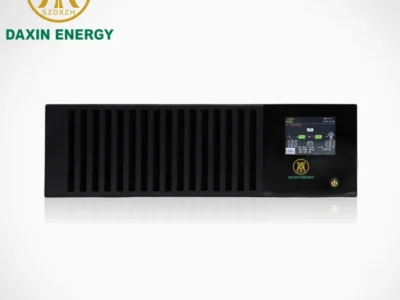
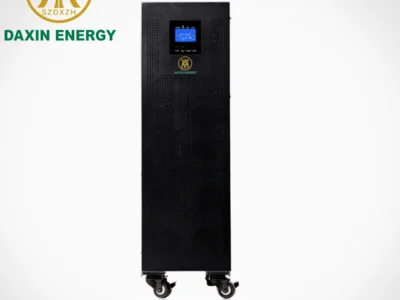
The DAXIN 3H3 500K-T is a low-frequency online UPS designed for large critical-power applications requiring three-phase input and three-phase output power protection.
Son architecture triphasée 3/3 est destinée aux installations dans lesquelles tant l'alimentation électrique entrante que les charges critiques protégées fonctionnent en courant triphasé.
The 3H3 500K-T is positioned for large industrial, data center, infrastructure and other mission-critical projects where UPS capacity, battery autonomy, bypass architecture, communications and redundancy requirements must be engineered according to the site.
Final electrical ratings, battery configuration, runtime, dimensions, weight, communication interfaces and optional functions are subject to the approved DAXIN technical specification and project proposal.
Principaux avantages
- Architecture triphasée : Three-phase input and three-phase output support large three-phase critical-power systems.
- Conception d'un onduleur à basse fréquence : Intended for demanding industrial, infrastructure and mission-critical power applications.
- Protection de l'alimentation électrique en ligne : Provides conditioned power protection for sensitive and critical electrical loads.
- Project-Engineered Battery Runtime: Battery configuration and backup duration can be engineered according to connected load and project requirements.
- Surveillance et protection : Display, alarm, bypass, protection and communication functions support system operation and maintenance according to the selected configuration.
- Redundancy Planning: Parallel and redundancy architecture can be reviewed according to project requirements and the capabilities of the selected configuration.
- Configuration par projet : Final capacity, voltage, battery system, bypass, communications and installation requirements are confirmed before ordering.
Que signifie « 3/3 phases » dans un onduleur ?
Un onduleur triphasé 3/3 utilise une alimentation triphasée en courant alternatif en entrée et fournit une alimentation triphasée en courant alternatif en sortie.
This architecture is commonly used for large critical loads in industrial facilities, data centers, power infrastructure, healthcare systems, transportation facilities and other three-phase electrical environments.
The DAXIN 3H3 500K-T uses this three-phase input and three-phase output architecture for large critical-power applications.
How Is a Large-Capacity UPS System Sized?
Large-capacity UPS sizing should begin with the measured critical load in both kW and kVA rather than selecting a UPS from the model designation alone.
The engineering calculation should consider load power factor, peak demand, future expansion, required operating margin, battery autonomy, redundancy architecture and the operating characteristics of the connected equipment.
For a DAXIN 3H3 500K-T project, provide the load list, single-line diagram, site voltage and frequency, required backup time, redundancy target and installation conditions before final system selection.
Présentations des produits et documentation technique
Applications typiques
- Large data centers and mission-critical IT facilities
- Industrial plants and manufacturing facilities
- Power generation and utility infrastructure
- Telecom core facilities
- Hospitals and large healthcare campuses
- Transportation, railway and tunnel infrastructure
- Commercial and public infrastructure
- Other large three-phase critical-power systems
How to Select a Large-Capacity 3/3 Phase UPS
Select the UPS according to the measured critical load in kW and kVA, power factor, peak demand, input and output voltage, required operating margin, future expansion, battery autonomy, bypass architecture, redundancy target, communication requirements and installation environment.
For a 3/3 phase UPS, confirm that both the facility electrical supply and protected critical loads require three-phase power.
Large-capacity UPS projects should also evaluate upstream and downstream protection coordination, generator compatibility, battery-system architecture, maintenance access, ventilation, floor loading and system redundancy before final equipment selection.
Provide DAXIN ENERGY with the load list, single-line diagram and site requirements for project-specific UPS and battery configuration.
Foire aux questions
Ce produit peut-il être configuré pour un projet spécifique ?
Oui. La configuration électrique, l'autonomie de la batterie, les systèmes de communication, le contournement, la disposition des armoires et les accessoires du projet peuvent être examinés en fonction des exigences du site.
Les notes techniques sont-elles toutes communes à l'ensemble de la série ?
Non. Les caractéristiques techniques et les fonctions varient selon le modèle et la configuration. Veuillez vous référer à la fiche technique spécifique au projet comme référence définitive.
DAXIN ENERGY peut-elle vous aider à choisir un système ?
Oui. Veuillez nous fournir la liste des charges, la phase et la tension, la durée de fonctionnement requise, l'objectif de redondance, les exigences en matière de communication et l'environnement d'installation.
Demander une configuration de projet
Envoyez-nous les données de charge, le schéma unifilaire, le temps de secours requis et les conditions sur site afin de recevoir une proposition sur mesure concernant un onduleur ou une batterie.
What is the DAXIN 3H3 500K-T?
The DAXIN 3H3 500K-T is a low-frequency 3/3 phase online UPS designed for large critical-power applications.
Que signifie « 3/3 phases » ?
It means the UPS uses three-phase AC input and provides three-phase AC output.
What is the rated capacity of the 3H3 500K-T?
The final rated capacity and active-power rating should be confirmed against the approved DAXIN 3H3 500K-T technical specification.
Can battery runtime be customized?
Yes. Battery autonomy can be engineered according to connected load, required backup duration and the approved battery-system configuration.
Can the 3H3 500K-T be configured for redundant operation?
Parallel and redundancy capabilities depend on the selected configuration and must be confirmed during project engineering.
What information is required for system selection?
Provide the critical load in kW and kVA, site voltage and frequency, single-line diagram, required runtime, redundancy target, bypass requirements, communications, installation environment and available space.
Avis
Il n’y a pas encore d’avis.