












Sistemas de almacenamiento de energía con baterías refrigerados por líquido frente a los refrigerados por aire: cómo elegir
Battery energy storage projects are becoming more demanding. Commercial and industrial sites want peak shaving, backup power, solar self-consumption, EV-charging support, and increasingly responsive grid services from equipment that must operate safely for years. The cooling architecture inside the system therefore deserves the same attention as the battery cells, inverter, fire protection, and energy-management software.
The central choice is often between a liquid cooled battery energy storage system and an air cooled BESS. Liquid cooling can provide more uniform temperature control and support compact, high-power layouts, while air cooling can offer a simpler architecture and easier service access in suitable applications. Neither approach is universally superior. The right answer depends on power and energy requirements, ambient conditions, duty cycle, enclosure design, service strategy, and the way the complete ESS is integrated.
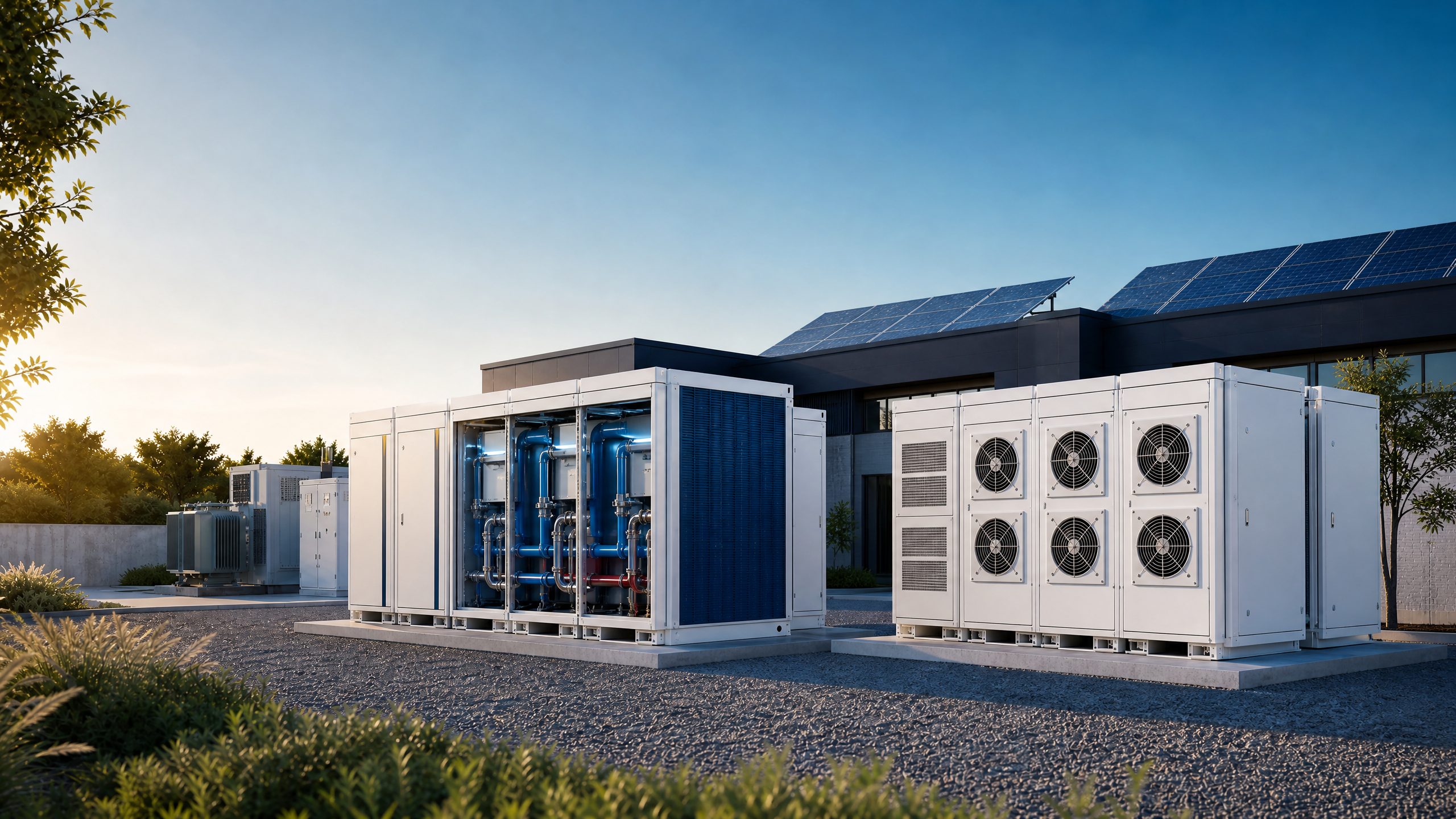
Why battery thermal management matters in BESS design
Battery cells generate heat during charging and discharging. The amount depends on current, cell chemistry, internal resistance, state of charge, operating temperature, and the requested power profile. A battery thermal management system (BTMS) removes or distributes that heat and helps keep the battery within its intended operating window.
Thermal management is not only a comfort or efficiency feature. Temperature differences between cells can contribute to uneven aging, altered available capacity, and operating limits imposed by the battery-management system. A well-designed system aims for controlled temperatures across modules and racks, while also coordinating sensors, pumps or fans, controls, alarms, HVAC, and protective shutdown logic.
The wider market context explains why this engineering question matters. The International Energy Agency reported that power-sector battery storage deployments more than doubled year on year in 2023, adding 42 GW globally, and identifies batteries as an important source of short-term flexibility for modern power systems.[1] As more projects combine renewable generation, large loads, and fast dispatch, thermal design becomes part of the bankability and operability discussion rather than an afterthought.
How air-cooled BESS works
An air cooled BESS uses fans and heat exchangers, generally with conditioned air circulated through the battery enclosure or across battery modules. Depending on the design, the system may use forced air, cabinet-level air conditioning, or a combination of ventilation and HVAC. The goal is to move heat from the cells to the surrounding air and then reject it outside the enclosure.
Air cooling is familiar to many integrators and can be attractive where the power level is moderate, the enclosure has sufficient space for airflow paths, and the site environment is manageable. It avoids liquid circuits, pumps, coolant quality management, and associated leak-detection considerations. However, airflow must be carefully designed. Rack position, module spacing, filters, fan curves, ducting, and recirculation can all affect whether the hottest areas receive adequate cooling.
Air cooling also introduces moving parts and acoustic considerations. Fans may create a noticeable sound profile, particularly when the system is working hard in a hot environment. Dust, pollen, salt, and other contaminants can affect filters and heat exchangers if the enclosure and maintenance plan are not matched to the site.
How a liquid cooling ESS works
A liquid cooling ESS transfers heat through a coolant loop connected to cold plates, cooling panels, or other thermal interfaces near the battery modules. The loop typically includes a heat exchanger or chiller, pumps, valves, sensors, controls, and a coolant circuit. The exact configuration varies by system architecture and must be assessed as part of the complete containerized energy storage design.
Liquid has a higher heat-transfer capability than air in a compact volume, which can help a system remove heat close to the source. With a properly engineered loop, the design can reduce temperature gradients across modules and racks. That thermal uniformity is especially relevant when a high power BESS is expected to charge and discharge at demanding rates or operate repeatedly during hot weather.
The trade-off is greater system complexity. A liquid cooled battery energy storage system requires attention to pump reliability, coolant compatibility, seals, piping, expansion behavior, leak detection, service isolation, controls, and the heat-rejection unit. These are manageable engineering issues, but they must be documented, commissioned, and maintained rather than assumed away.
Liquid-cooled vs air-cooled BESS: clear difference table
The following comparison is a design framework, not a claim about every product in the market. Actual results depend on cell chemistry, rack layout, controls, ambient conditions, and the supplier’s complete system design.
| Evaluation area | Liquid-cooled battery energy storage system | Air-cooled BESS |
|---|---|---|
| Thermal uniformity | Can provide close-to-source heat transfer and more even temperatures when the coolant loop and interfaces are well designed. | Depends strongly on airflow distribution, enclosure geometry, fan control, and the distance between modules and heat-rejection paths. |
| Power density | Often well suited to compact, high-power layouts because heat can be managed in a relatively small thermal path. | May require more airflow volume, spacing, or HVAC capacity as heat load and power density increase. |
| Auxiliary energy | Pumps and heat-rejection equipment consume auxiliary power; the project should evaluate operation across the full ambient range. | Fans, blowers, and air-conditioning equipment consume auxiliary power; consumption varies with airflow resistance and ambient temperature. |
| Maintenance | Requires inspection of pumps, coolant circuit, valves, sensors, seals, and leak-detection functions, as applicable. | Requires inspection or replacement of fans, filters, ducts, heat exchangers, and air-conditioning components, as applicable. |
| Ruido | Pump and chiller noise still matter, but the acoustic profile may differ from high-speed fan systems. | Fan and compressor noise can be material near commercial buildings or noise-sensitive boundaries. |
| Environmental conditions | Enclosure, coolant, corrosion protection, condensation control, and heat rejection must be selected for the site. | Filtration, ingress protection, corrosion control, HVAC sizing, and outdoor air exposure are critical. |
| System integration | Adds thermal-loop interfaces to controls, auxiliaries, alarms, fire strategy, and commissioning procedures. | Usually presents a simpler thermal interface, but airflow and HVAC behavior must still be integrated with BMS, EMS, and safety controls. |
| Best-fit tendency | Frequently considered for high-power, high-density, or challenging thermal-duty applications. | Frequently considered where loads, climate, enclosure space, and service conditions support a simpler air path. |
Why liquid cooling is relevant to high-power containerized ESS
A containerized energy storage system concentrates many battery racks, power-conversion components, controls, and safety systems in a constrained footprint. Increasing the power rating or the frequency of cycling increases the importance of removing heat consistently from the battery area. Liquid cooling is relevant in this context because a distributed coolant loop can bring thermal control closer to the modules, potentially supporting uniformity without relying on large air volumes moving through every part of the container.
That does not mean liquid cooling automatically delivers a better project. The container must still have suitable thermal interfaces, controls, service access, auxiliary-power architecture, fire-safety coordination, and heat rejection for the climate. A poorly integrated liquid system can be less attractive than a well-designed air system. Conversely, selecting air cooling for a dense, frequently cycled installation without verifying airflow and derating behavior can create avoidable operating constraints.
DAXIN ENERGY’s published product categories include commercial and industrial energy storage systems, liquid-cooled container energy storage systems, outdoor energy storage cabinets, high-density battery packs, and battery cabinets.[2] Its solutions positioning covers commercial and industrial ESS, solar plus storage, EV-charging plus ESS, data-center backup power, and utility-scale energy storage.[3] These categories show why the cooling decision should be discussed within the full application rather than as an isolated component choice.
Selection criteria for commercial and industrial projects
1. Start with the duty cycle, not just the nameplate
Define the required charge and discharge power, expected duration, daily cycles, ramp rate, standby periods, and seasonal operating pattern. A system used for occasional backup may have a different thermal profile from one providing daily peak shaving, demand response, or fast EV-charging support. Ask the supplier to show how thermal controls behave across the actual operating envelope.
2. Evaluate site climate and enclosure conditions
Record the design ambient temperature range, solar exposure, humidity, altitude, dust, salt, available ventilation, and noise limits. Outdoor equipment may face conditions that are very different from a clean indoor electrical room. Thermal performance should be assessed together with ingress protection, condensation prevention, corrosion protection, and maintenance access.
3. Compare total auxiliary energy and service requirements
Do not compare only the battery-side cooling components. Review fans, pumps, chillers, compressors, heaters, controls, and standby consumption over a representative year. Then compare filter changes, coolant checks, pump or fan replacement, spare-parts availability, and the skills needed for field service. These operating details affect lifecycle cost and availability.
4. Confirm system integration responsibilities
The thermal system must communicate with the BMS, energy-management system, power-conversion system, HVAC controls, fire detection, and site SCADA where applicable. Clarify which party owns alarms, setpoints, interlocks, remote monitoring, firmware coordination, and emergency shutdown logic. Integration drawings and cause-and-effect documents should be reviewed before equipment is ordered.
5. Match thermal architecture to future expansion
If the project may add racks, increase utilization, or combine solar and EV charging later, ask whether the cooling and auxiliary systems can accommodate the intended expansion. Expansion is not guaranteed simply because spare electrical capacity exists; thermal capacity, control logic, space, and heat rejection may also become constraints.
Commissioning questions to ask before handover
A disciplined commissioning process turns the cooling choice into measurable acceptance criteria. Project teams should ask:
- What temperature uniformity limits and sensor validation procedures apply across modules, racks, and operating states?
- What happens when a fan, pump, chiller, sensor, valve, filter, or communications link fails?
- What are the auxiliary loads at standby, normal operation, peak ambient, and maximum requested power?
- Which alarms trigger power derating, controlled shutdown, or emergency isolation?
- How are coolant leaks, low flow, blocked filters, excessive temperatures, and condensation detected and recorded?
- Has the system been tested at the site’s expected ambient, humidity, noise, and grid operating conditions, or are some results based only on factory tests?
- Which maintenance tasks are owner responsibilities, and which require an authorized service provider?
- Are thermal alarms visible in the site SCADA or remote-monitoring platform with clear timestamps and event history?
- Have the BMS, PCS, EMS, HVAC, fire-safety, and emergency-response interfaces been tested together rather than separately?
- What documentation will be delivered, including as-built drawings, setpoints, commissioning records, maintenance intervals, spare-parts lists, and troubleshooting procedures?
Practical conclusion: choose the architecture that fits the project
The difference between a liquid cooled battery energy storage system and an air cooled BESS is not simply “advanced” versus “basic.” Liquid cooling can be compelling for high-power, high-density, frequently cycled, or thermally challenging containerized ESS applications because it can bring heat transfer closer to the battery and support more uniform thermal conditions. Air cooling can remain a sensible option where the duty cycle, climate, enclosure layout, acoustic environment, and maintenance resources make its architecture appropriate.
The final selection should therefore follow a documented comparison of thermal performance, power density, auxiliary energy, maintenance, noise, environmental conditions, and system integration. Request application-specific design information rather than relying on a generic technology label. To review DAXIN ENERGY’s energy-storage product categories, visit the DAXIN ENERGY Products page; for application context, see its Solutions page. When the project has defined its power, energy, climate, and operating requirements, teams can use the Página de consultas de DAXIN to discuss the appropriate system architecture without presuming a specification before engineering review.
Referencias
[1] International Energy Agency, “Batteries and Secure Energy Transitions—Executive Summary” (2024)