












The DAXIN Outdoor Integrated UPS System is a configurable backup power solution for telecom, traffic, surveillance, industrial and other critical outdoor loads. It integrates UPS conversion, battery connections, power distribution, maintenance bypass, communication and thermal management inside a project-specific protective cabinet.
The system is engineered according to the actual load, required backup time, input and output configuration, ambient conditions, monitoring requirements, destination country and applicable project standards.
To receive a preliminary configuration, provide the connected load, input and output voltage, required runtime, ambient temperature, installation country and project quantity.
Selection starts with the actual load and required backup time. Input and output configuration, battery solution, ambient conditions, enclosure protection, monitoring, destination country and applicable standards must also be confirmed before the final design.
Lösungsübersicht
Outdoor telecom, traffic, surveillance, industrial and edge equipment can face utility outages, voltage fluctuation, heat, dust, humidity and delayed maintenance. The DAXIN solution is configured around the site rather than a fixed catalogue rating, reducing the risk of oversizing, undersizing or specifying the wrong environmental arrangement.
When Is an Outdoor Integrated UPS System Recommended?
An outdoor integrated UPS system is typically recommended when critical equipment is installed outside a conventional equipment room, utility power is unstable, backup time must be project-specific, or several power and environmental functions need to be integrated into one cabinet.
- Remote sites with delayed maintenance access
- Telecom and network equipment requiring continuous operation
- Traffic, surveillance and access-control installations
- Industrial control equipment exposed to outdoor conditions
- Projects requiring integrated UPS, batteries, distribution and monitoring
For indoor equipment rooms with stable environmental control, a standard indoor UPS configuration may be more appropriate.
Outdoor Integrated UPS System vs Standard Indoor UPS
| Comparison | Outdoor Integrated UPS System | Standard Indoor UPS |
|---|---|---|
| Installation environment | Outdoor or uncontrolled project environments | Indoor controlled equipment rooms |
| System integration | UPS, batteries, distribution, bypass, monitoring and cooling can be integrated | External cabinets and supporting systems may be required |
| Environmental protection | Configured according to site conditions | Normally depends on the building environment |
| Thermal management | Selected as part of the cabinet design | Normally provided by the equipment room |
| Personalisierung | Project-specific | Primarily based on standard product ratings |
Systemarchitektur
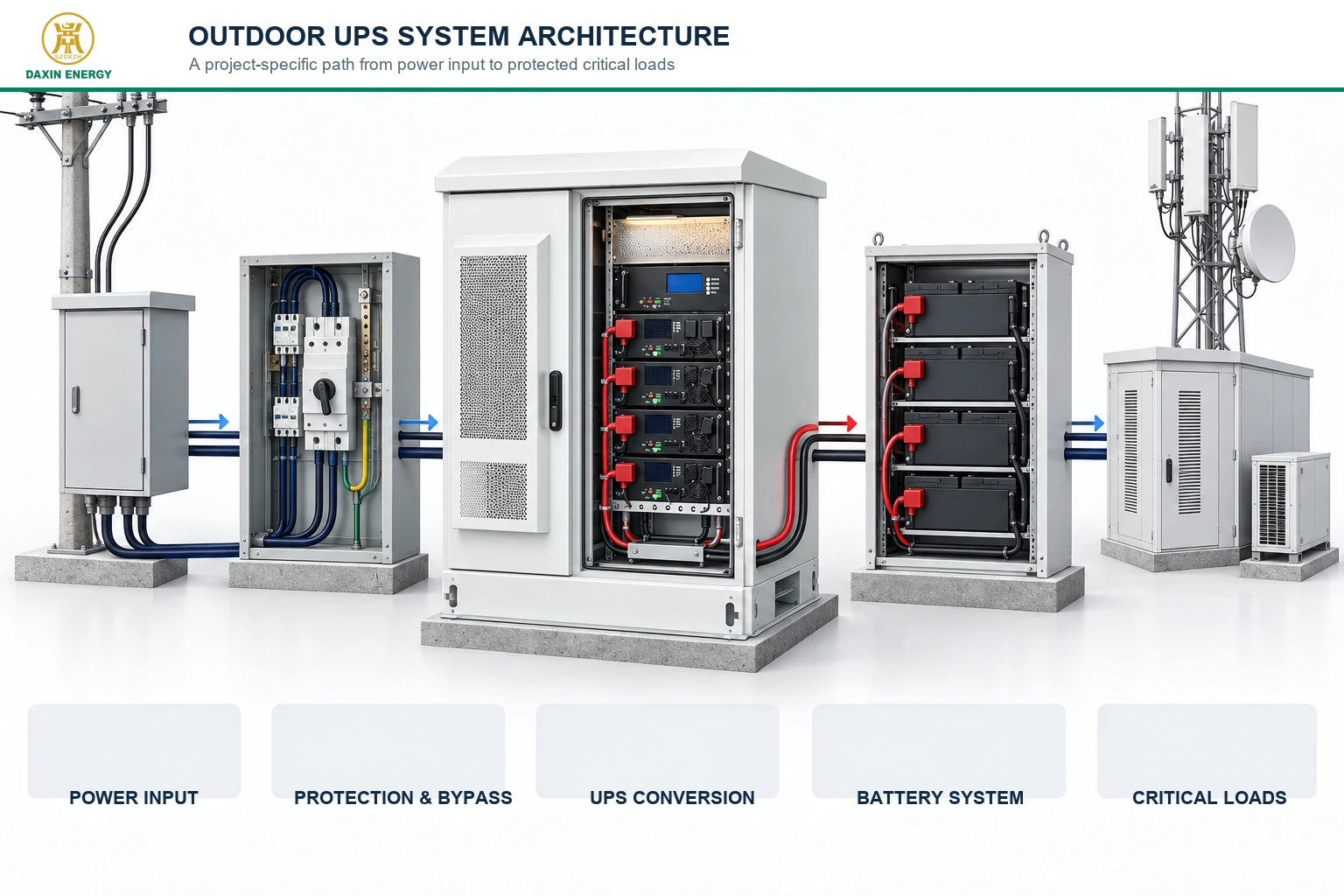
A typical system is organized around power input, protection and optional maintenance bypass, UPS conversion, energy storage and critical loads. Final quantities and connections are defined by the approved single-line diagram and technical proposal.
Main System Components
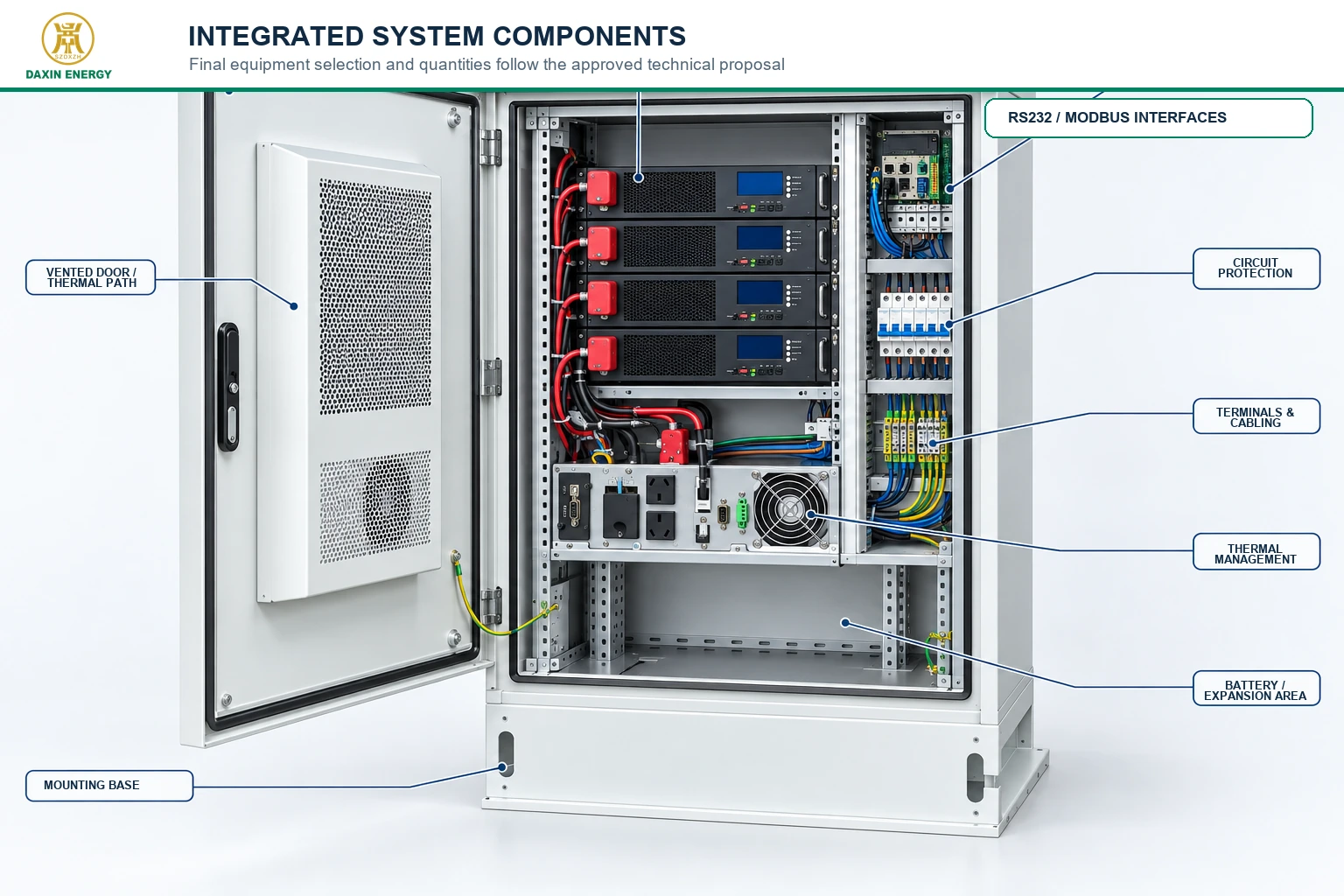
- Outdoor enclosure: protects the internal equipment; material, dimensions and protection rating are confirmed per project.
- UPS modules: selected for load capacity, phase configuration, redundancy and expansion.
- Battery system: sized from load, runtime, temperature and the approved battery technology.
- Distribution and protection: approved switching, circuit protection, terminals and cable organization.
- Maintenance bypass: a controlled service path when required by the project.
- Thermal management: fan, heat-exchanger or cabinet air-conditioning options selected from ambient temperature and internal heat load.
- Communication: RS232 and Modbus are visible on the reference equipment; other protocols and remote monitoring are confirmed per project.
Operating Logic
| Operating state | System behavior | Customer outcome |
|---|---|---|
| Utility available | The UPS supplies conditioned power and manages the battery according to system settings. | The critical load continues operating and backup remains available. |
| Utility abnormal or lost | The UPS supports the critical load from the battery side according to its design mode. | Reduced risk of outage-related downtime. |
| Utility restored | The system restores the normal supply path and manages battery recovery. | Equipment remains operational and backup capability is restored. |
| Planned maintenance | Controlled service may be performed when maintenance bypass is configured and approved procedures are followed. | Reduced maintenance impact on critical loads. |
Priority Applications
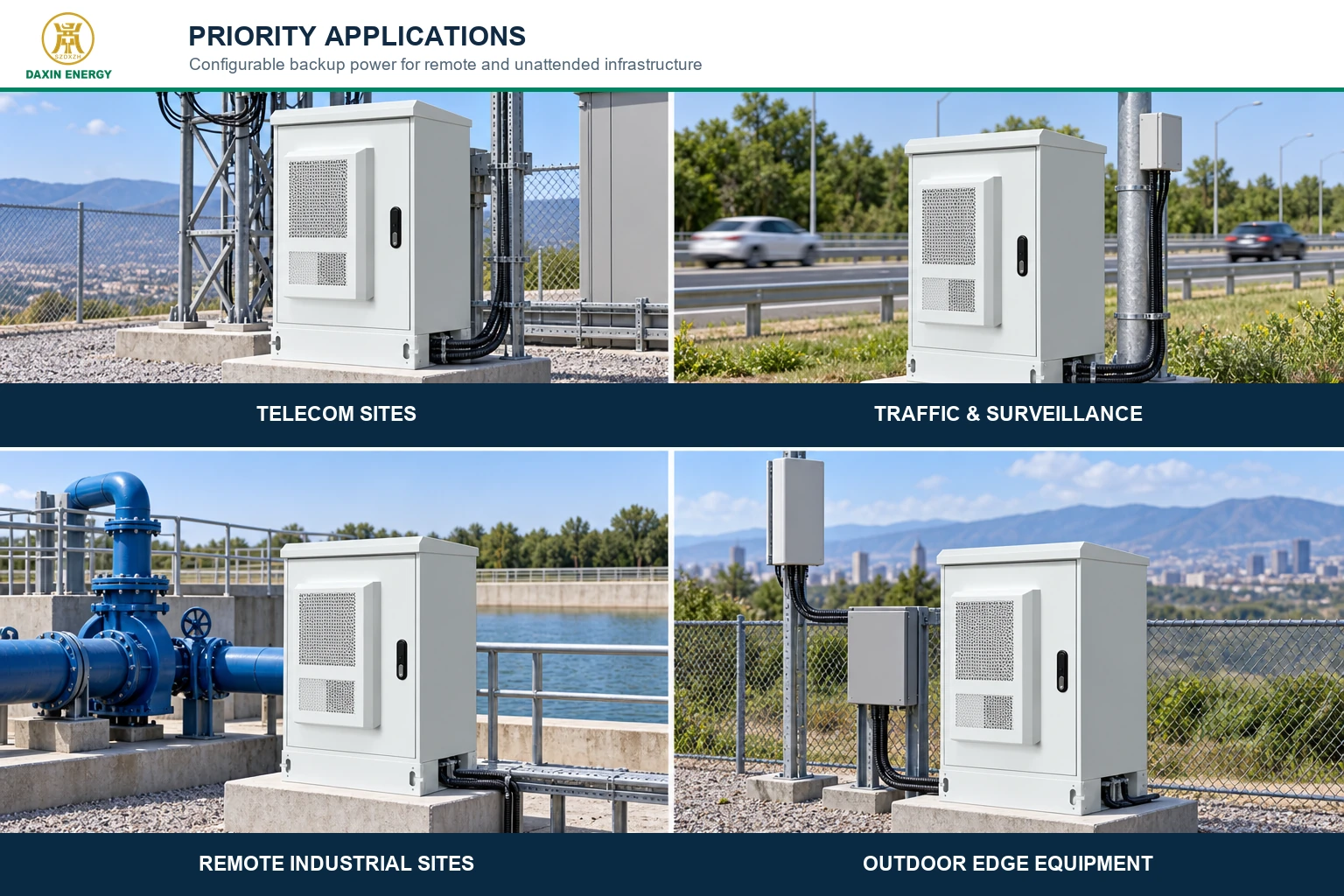
- Telecom sites: base stations, fiber, wireless and outdoor communication equipment.
- Traffic and surveillance: signals, roadside monitoring, toll stations, cameras and access control.
- Remote industrial sites: oil and gas, mining, pumping, substations and remote controls.
- Outdoor edge equipment: network cabinets, small communication nodes and edge computing equipment.
Project Sizing Method
- Define the equipment list, running power, inrush and criticality.
- Confirm voltage, frequency, phase and grounding.
- Set the required backup duration.
- Review temperature, humidity, dust, rain, altitude and corrosion conditions.
- Confirm local display, protocols, alarms and remote platform requirements.
- Confirm country standards, documents, certification scope, packaging and delivery schedule.
Runtime must be calculated using actual load, battery capacity, battery condition, discharge rate and ambient temperature. Nominal capacity alone is not sufficient.
Customization Scope
DAXIN can evaluate UPS capacity, input and output voltage, frequency and phase; battery type and runtime; cabinet dimensions, material, color, doors and cable entry; cooling; distribution and bypass; communication; alarms; remote monitoring; branding; packaging; and OEM or ODM requirements.
Testing and Acceptance
Final test methods and acceptance criteria are defined in the approved technical agreement. Typical project discussions cover assembly and grounding, input and output wiring, normal and abnormal supply operation, battery logic and runtime, display and communication, thermal management, accessories, documentation and packaging.
Information Required for a Proposal
- Load equipment, quantity, running power and starting characteristics
- Input and output voltage, frequency, phase and grounding
- Target runtime and critical-load priority
- Site temperature, humidity, altitude and environmental conditions
- Enclosure protection, dimensions, material and installation constraints
- Protocols, alarms and remote monitoring requirements
- Country, standards, certification and document requirements
- Quantity, delivery schedule, packaging and transport method
Request a Configuration and Quote
Send DAXIN your load, input and output voltage, required backup time, ambient temperature, installation country and quantity. Our engineering team will evaluate the UPS capacity, battery solution, enclosure protection, thermal management and monitoring configuration.
Final performance, dimensions, certifications, delivery scope and acceptance criteria are governed by the mutually approved technical agreement, formal datasheet and contract.
Häufig gestellte Fragen
What is an outdoor integrated UPS system?
An outdoor integrated UPS system combines UPS conversion, battery connections, distribution, protection, communication and thermal management inside a protective outdoor cabinet.
How is the required UPS capacity selected?
UPS capacity is selected from the actual running load, starting characteristics, load criticality, future expansion and required redundancy. The final rating must be confirmed through project calculations.
How is battery backup time calculated?
Runtime depends on the connected load, battery capacity, battery technology, discharge rate, battery condition and ambient temperature. Nominal battery capacity alone is not sufficient.
Can the system support remote monitoring?
Remote monitoring can be evaluated according to the required communication protocol, alarm points and management platform. RS232 and Modbus are visible on the reference equipment, while other options require project confirmation.
Can the cabinet protection rating be customized?
Cabinet material, construction and protection arrangement can be selected according to rain, dust, humidity, temperature, altitude and corrosion conditions. The final protection rating is stated in the approved technical proposal.
Welche Angaben werden für ein Angebot benötigt?
Please provide the load, voltage, phase, frequency, required backup time, ambient conditions, installation country, monitoring requirements, quantity and delivery schedule.
Telekommunikations-Energielösungen